The Spotted One
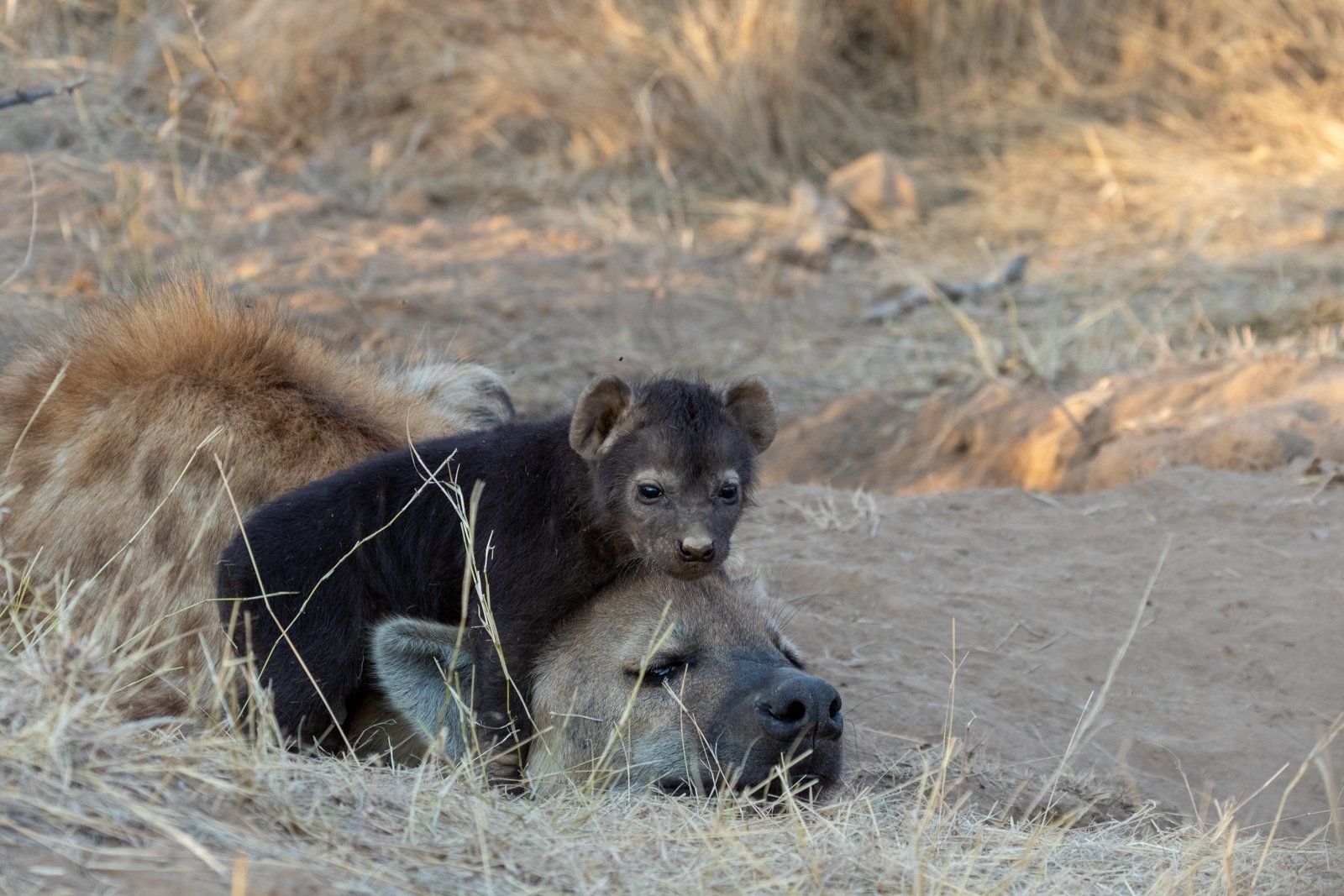
For the last few weeks since we discovered the latest spotted hyena den we have been having some incredible sightings of the two newest pups who are still in their imitation black bear cub stage.
This has inspired us to do some more research on this most fascinating of species and we want to share some of the fun filled facts with you if only to help dispel the Spotted On'e bad rep.
Let’s begin with conception , unlike most other mammals , the female is completely in control over mating and because of the unconventional nature of their sexual genitalia , not having a conventional vaginal opening the male cannot force himself on her. Her pseudo penis is a similar length to that of the adult male and she even has a pseudo scrotum albeit an empty sac. Visually the difference between the two is that the male’s penis is pointed at the end and the female’s pseudo penis has a rounded end. Due to the length and brow opening of the birth canal , her very first litter , which can be during her third year , is often still born. Hyena lifespan can be nineteen years.
So she gets to choose which male she mates with and young females especially will prefer males that were born into or that joined the group after she was born thus effectively avoiding incestuous breeding with her father for older brothers.
Given the time and investment she will have to put into the usual litter size of one or two cubs , just occasionally three, it seems only right that she gets to choose the male with the best genes.
It’s not so much the gestation period 0f 110 days , which is similar to other large carnivores but the very lengthy nursing of up to 15 months that makes raising her cubs so time hungry. Her milk has the highest protein content of any mammal and has a very high content as well. Consequently the cubs physical growth is rapid.
Hyena cubs are the most precocial of any mammal species. They are born averaging 1.5kgs but with eyes open and incisors and canines already erupted.
The mother and her litter will spend the first two weeks in the birth den in a separate location from the communal den before she moves the cubs to her communal den.
Hyena society is intensely matriarchal as the female has a higher level of testosterone and is larger than most males. The competition amongst cubs especially if they are both female is intense , and the second to arrive , usually one hour later, can succumb to starvation as the first cub will dominate.
It is the young male who usually will leave the clan in their fourth year and research shows they will home in on a clan with the highest number of young males which makes sense in that they start at the bottom of the ladder of the social ranking so their climb up should be shorter in such a clan. Clan size in some areas can be up to 130 members in which there is a strict linear dominance hierarchy in which all females and their young dominate all immigrant males.
The spotted hyena is the large carnivore with by far the greatest population compared with other large carnivore species in Africa , although they are now confined to Sub Saharan Africa.
Despite their reputation as the scavenger of the bush the truth is that on average lion scavenge more meals than spotted hyena. The spotted hyena is a skilled and successful hyena weighing in up to just below 60 kgs , and can singly take down prey up to 180kg in weight and when hunting in groups will hunt down zebra, wildebeest, and buffalo. It can consume 15kgs of prey which is 25% of its own body weight and because of its incredible stamina even though it may have spent one hour chasing down its prey it can start eating immediately, before lion come to rob them of their prey. The biting force is considerable and is 40% more than a male lion hence it’s ability to crush bones so easily
Finally it plays a very important role in keeping diseases that are very harmful to other species , including us , ie anthrax by consuming carrion riddled with same with no ill effects for itself.