From fishing owls to giant herons...
The beautiful Olifants River runs along the northern border of Olifants West Nature Reserve within the Greater Kruger on its way to join the Limpopo in Mozambique, creating a magnificent habitat for a variety of riverine birds that draw birders from all over the world.
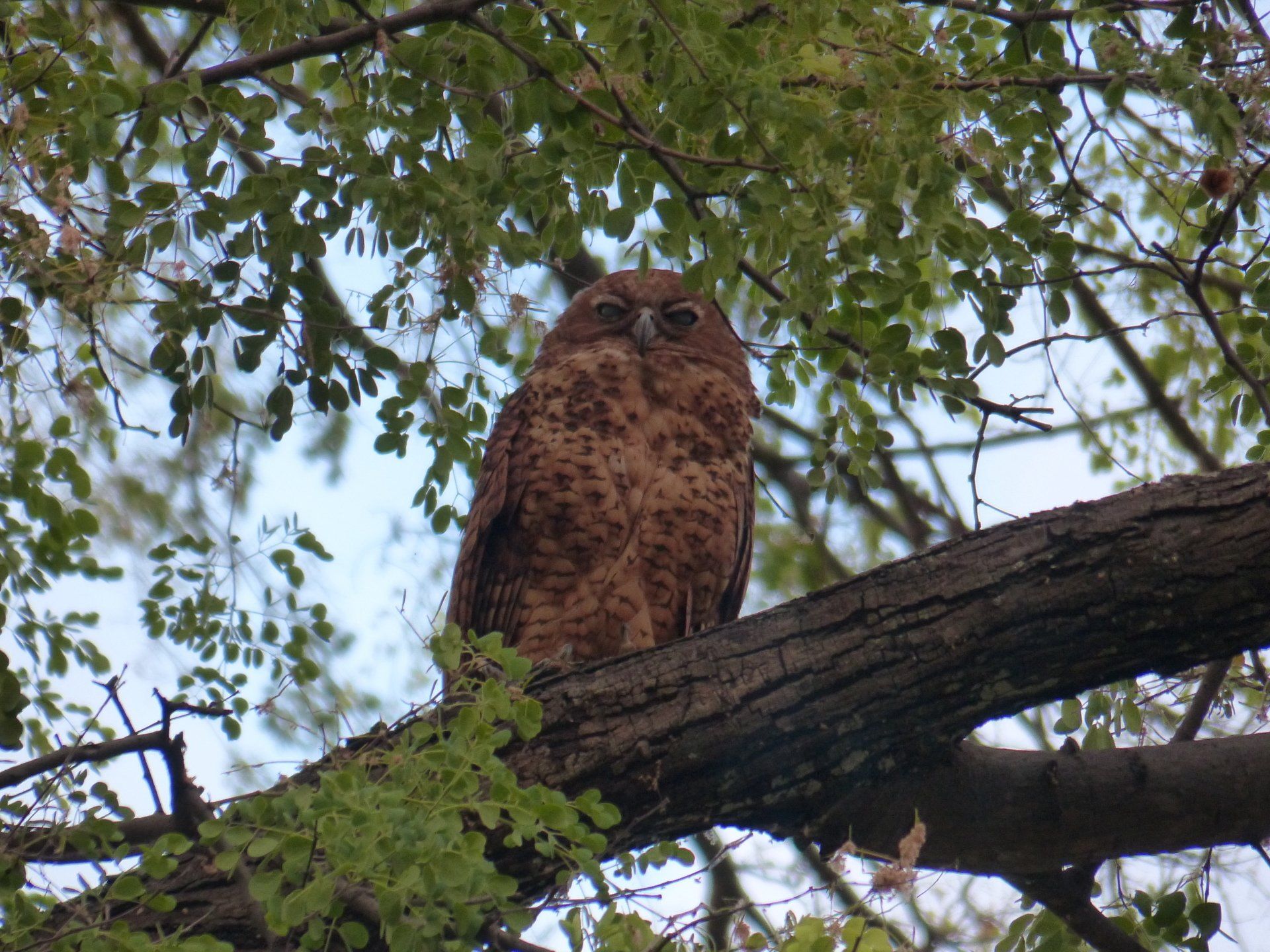
Here at Sausage Tree Safari Camp we're lucky enough to have a 5km stretch of the river as part of our traversing . Located west of the Olifants River Bridge, this is where we get regular sightings of the inimitable Pel's fishing owl, not to mention African fish eagles, yellow-billed storks, saddle-billed storks, goliath heron, giant kingfishers, pied kingfishers and African spoonbills...
The Pel's fishing owl is one of the largest owls in the world and is found along rivers and lakes throughout sub-Saharan Africa. Their favourite habitat is riparian forests with large trees, such as we have along the Olifants. They're residential in habit, so don't migrate but are territorial, staking out portions of river bank and lake-front to call their own.
Although mostly nocturnal, we have been fortunate to see Pel's during the day, especially when prey is scarce or hard to find in the winter. As their name implies, their main prey is fish and they are able to catch fish up to 2kg in weight. They swoop down to catch fish just below the surface of the water with their powerful talons and don't submerge or get themselves too wet doing so.
During the summer, we're seeing a lot of yellow-billed storks and spoonbills and a general abundance of birdlife along the river. Yellow-billed storks are fascinating to watch as they wade the shallows in search of prey. They rely mostly on a sense of touch to find and catch small fish, crustaceans, aquatic insects and frogs, moving their heads and slightly opened bills to the left and right in gentle, swaying motions until their bills make contact with prey, whereupon it snaps shut in a reflex motion. The stork then raises its head and swallows its prey whole.
The yellow-billed stork also uses its feet in its search for food, using a stirring technique to churn the water and the soft silt on the river floor, disturbing prey that might be sheltering in vegetation along the banks. You'll often see them following crocodiles or hippos, feeding on whatever these two animals stir up with their movement through the water.
The African spoonbill has an unmistakable appearance thanks to the spoon-like shape of the end of its bill. Related to the ibis, like the yellow-billed stork it patrols the shallows along the banks of the Olifants River, looking for fish and occasionally molluscs. Also like its stork "cousin" it swings its head from side to side in the water with its bill slightly open, catching prey mostly through touch rather than relying on vision.
We're also blessed with a variety of kingfishers, from the spectacular giant kingfisher to the beautiful pied kingfisher, as well as the pygmy and malachite. The giant kingfisher is the largest of the African kingfisher species and chooses a stationary perch from which to hunt, diving down into the water and submerging itself to catch its prey which it then carries back to a perch to devour, swallowing it whole, head first.
The pied kingfisher is very active along the banks of the river, flitting from perch to perch in search of prey. It feeds mainly on fish but will also eat crustaceans and dragonfly larvae. You'll often see it bobbing its head up and down as it scans the surface of the water for signs of prey. When it sees something that interests it, it will fly from its perch and hover over a patch of water, keeping its head still as it watches for prey, then diving down into the water to make a catch, which if small enough can be swallowed in flight.
The Olifants is also home to the world's largest heron - the goliath heron. At anywhere up to a metre and a half in height, with a wingspan of up to 2,3m and weighing in as much as 5kg, the goliath heron is also one of the most aquatic of all herons. It rarely ventures away from water and prefers to fly along waterways rather than over land.
Preying primarily on large fish, goliath herons are solitary birds and are highly territorial too. It hunts by standing still in the shallows, watching the water at its feet exceptionally closely. As prey comes close it spears it with an open bill, swallowing it whole as quickly as it can. Sometimes it's not quick enough and its prey will be stolen by a fish eagle, which frequently follow goliath herons in search of easy meals.
These are just some of the amazing riverine birds you are likely to spot along the Olifants. If you're a keen birder, or have an interest in finding out more about birds, then we'd love to see you soon here at Sausage Tree Safari Camp.